
Franco-Era Spanish descendants have long had a complicated relationship with the Spanish citizenship process. Previously, only children of those who were Spanish citizens at the time of their birth qualified. In 2007, the Historical Memory Law granted a pathway to children of Franco-era victims. And in 2022, the Democratic Memory Law created a pathway that extended to grandchildren of Franco-Era victims, as well.
Spain’s Democratic Memory Law came to an official end in October 2025, and the rush to apply has led to a huge influx in Spanish nationality cases.
- More than 1 million applications have been initiated.
- Roughly 1.3 million applications are pending processing.
The recent inundation has put a significant strain on Madrid’s consulate and consular offices around the world.
Spain’s Democratic Memory Law: A Complex History
Also known as the Grandchildren’s Law, Spain’s Democratic Memory Law began just over three years ago, in October 2022.
Since its start, Spanish citizenship by descent cases have risen, owing to more than 2.3 million applications (including those filed and appointment-pending) from descendants of Spanish citizens who fled Spain between 1936 and 1978, during Francisco Franco’s dictatorial rule and the Spanish Civil War.
The law, which attempted to achieve democratic progress and provide restitution for descendants of Franco-era victims, came to an end on October 22, 2025. In its wake, Spain faces an enormous backlog of citizenship by descent applications, as more than half of the applications submitted under this legislation are yet to be processed, with many appointments scheduled by applicants before the deadline ran out.
Pressure on Spain’s Consular Network
One of the most notable outcomes of the sheer amount of nationality applications filed under the Grandchildren’s Law is that Spain’s consulates – both global and domestic – are now burdened by a backlog.
According to Euronews, authorities involved in application processing estimate that this backlog of Spanish citizenship by descent cases could take as long as decades to work through.
What does this mean for applicants?
This time crunch presents an unfortunate problem. Older, and especially elderly descendants, applying for Spanish nationality through this pathway may not live to see their nationality requests approved.
An Unexpected Outcome for Spain
Spanish authorities were underprepared for the amount of applications, partly because the number of applicants exceeded expectations, and partly because the law was originally only intended to have a 2-year deadline before its extension in 2024.
Furthermore, the Grandchildren’s Law extended citizenship provisions to more than just descendants of Franco-era victims of political or religious exile. It also extended citizenship by descent rights to descendants of those who lost Spanish citizenship due to sexual orientation.
Applications in Comparison: Democratic Memory Law vs. the 2007 Historical Memory Law
Another notable outcome of applicants racing to get their cases underway is that the current Spanish citizenship by descent cases largely outnumber the cases under Spain’s Historical Memory Law of 2007.
The 2007 legislation gave eligibility to first-generation descendants (children); the 2022 legislation extended those provisions to grandchildren, as well.
Spain’s Democratic Memory Law of 2022-2025 led to almost five times more citizenship by descent applications than the 2007 Historical Memory Law, which saw just over 500,000 case requests.
The Data at a Glance: Applications Abroad
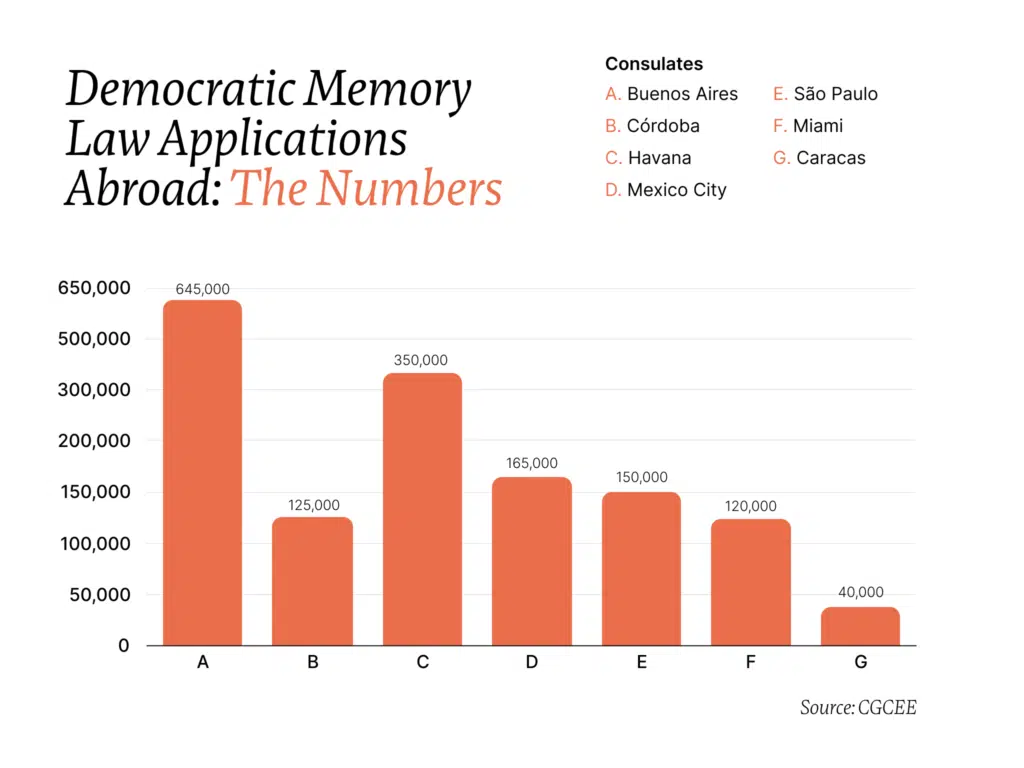
According to the General Council of Spanish Citizenship Abroad (CGCEE), Argentina makes up the majority of Democratic Memory Law applications, with almost 40% of the citizenship by descent applications coming from the South American country (645,000 in Buenos Aires and 125,000 in Córdoba).
Other major sources of applications outside of Spain include:
- Cuba: Havana’s consulate received 350,000 applications.
- Mexico: Mexico City’s consulate received 165,000 applications.
- Brazil: São Paulo’s consulate received 150,000 applications.
- United States: Miami’s consulate received 120,000 applications.
- Venezuela: Caracas’ consulate received 40,000 applications.
Going Forward: The Future of Spanish Citizenship By Descent
Facing the end of Democratic Memory Law, Spanish diasporas in communities around the world are stripped of their key pathway to citizenship by descent. Furthermore, those descendants no longer have this way of reclaiming what was taken from their ancestors at a time of deep political strife in Spanish history.
With the legislation no longer in effect, those who missed the deadline to submit applications or schedule consular appointments cannot apply for Spanish lineage citizenship outside of the jus sanguinis (bloodline) qualification. Going forward, only those who had at least one Spanish citizen parent when they were born qualify by descent.
In the meantime, Spanish consulates will be chipping away at roughly 2.3 million applications, which could take years or even decades to finish.
One Response
Do you think there will be any talk of a ‘grace period’ for applicants whose files were delayed by the consulate backlogs?