


If you have a Lithuanian ancestor, you may be wondering what rights you and your children have to claiming citizenship. Special birthright and lineage laws apply. Descendants of Lithuanian nationals can acquire Lithuanian citizenship by ancestry as far back as a great-grandparent if certain criteria are met.
Following more recent changes in the country’s citizenship policy, descendants can get citizenship as long as they prove that their parent, grandparent, or great-grandparent held citizenship and prove their relation to the ancestor.
Ways for Children to Qualify for Lithuanian Lineage Citizenship

A child qualifies as long as their direct ancestor – such as a parent, grandparent, or great-grandparent – held citizenship in the Republic of Lithuania before June 15, 1940. They may also qualify via birthright if you and/or one of your child’s parents holds citizenship. There are a few ways that this process works.
Children Get Lithuanian Citizenship by Birthright
According to the Citizenship Law of the Republic of Lithuania, children of Lithuanian citizens can acquire Lithuanian citizenship at birth. The law states that if one or both of the child’s parents are Lithuanian citizens when the child is born, the child automatically gains dual citizenship by descent, regardless of birth place. This is true even if the parent died before their birth.
Birthright citizenship also applies to children of stateless persons who legally reside in Lithuania, as long as the child doesn’t acquire the citizenship of another state at birth.
Children Can Claim Lineage Citizenship in Lithuania
If the child doesn’t qualify for birthright citizenship, they may qualify as a descendant of you, your parent, or your grandparent. The relevant ancestor must have held citizenship in Lithuania before Soviet occupation began on June 15, 1940.
Special Provisions for Descendants of Lithuanian Exiles
Note that children can still qualify for Lithuanian citizenship through ancestry, even if their ancestor voluntarily fled or was exiled from Lithuania. This is true if they were forcibly expelled between June 15, 1940, and March 11, 1990, and didn’t return to Lithuania during that time. It also applies if the ancestor fled during that time and was permanently living outside of Lithuania afterward.
Exceptions apply for descendants of ancestors who moved to Soviet territories during the time of occupation.
Does My Child Need to Be a Permanent Resident of Lithuania?
When considering citizenship applications, people often wonder whether their children can still qualify by descent while living abroad.
Note that the descendant does not have to be a permanent resident of the country to qualify for Lithuanian citizenship through ancestry. The descendant just needs to prove their direct relationship to the qualifying ancestor and the dates and status of the ancestor’s citizenship. Proving ancestry for citizenship can vary case by case, but it usually includes official records like birth certificates, marriage certificates, and other documents.
Exceptions and Limitations to Lithuanian Citizenship Through Ancestry
Keep in mind that there are special provisions that apply for children seeking citizenship in Lithuania by descent. The XI-1196 Citizenship Law of the Republic of Lithuania has been amended in the past decade. Articles 2, 7, and 9 of the law outline these exceptions for eligibility and application.
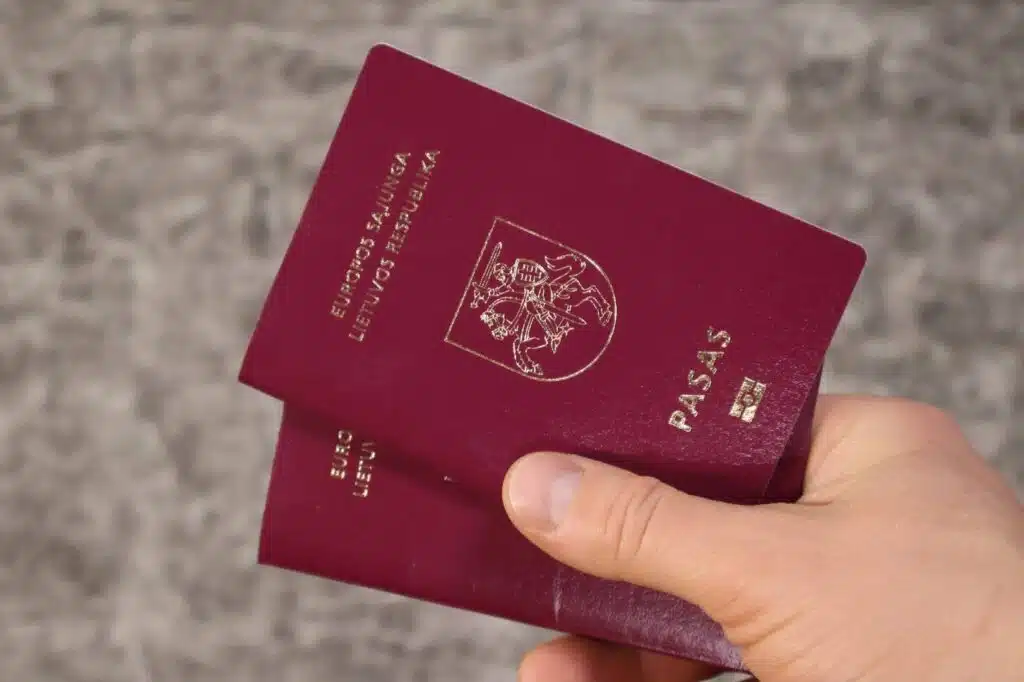
You can learn more about Lithuanian citizenship through ancestry by visiting our EU Citizenship page for Lithuania.
And, to check whether you and your family qualify for citizenship, start by taking our online assessment. We’ll connect you with trusted experts to guide you through your application.